Capstone Project:
LMS-Based Online Korean Course
Designed to solve pronunciation anxiety in remote learning, this scaffolded Korean course demonstrates a rigorous application of UDL principles and Quality Matters standards, ensuring high-quality engagement for any subject matter.


-
Audience: Beginner Korean language learners
-
Role: Instructional Design, eLearning Development (Bloom's Taxonomy, UDL, Quality Matters), Subject Matter Expert (SME)
-
Tools & Frameworks: Canvas LMS, Adobe Captivate, Articulate Storyline, Quality Matters (7th ed.), UDL, Canva, Capcut, Claude AI
My Process
This course was developed following the ADDIE model, ensuring a systematic and learner-centered design process from needs identification to final evaluation.
Analysis
To ground the course in real learner needs, I conducted a needs analysis identifying the core challenges beginner Korean language learners face: pronunciation anxiety, the absence of immediate corrective feedback, and difficulty retaining phonetic patterns without structured repetition.
Design
Learning objectives for all eight modules were developed in alignment with Bloom's Taxonomy and Quality Matters (7th ed.) standards. I leveraged Claude AI to generate initial drafts, then iteratively refined each objective against QM criteria, significantly reducing drafting time while maintaining rigorous alignment across all modules.
Development
Interactive learning activities were built using Adobe Captivate and Articulate Storyline, then embedded as HTML5 modules directly into Canvas LMS. Canva and Capcut were used to develop visual assets and video content that reinforced key phonetic concepts.
Implementation
The course was deployed on Canvas LMS with intuitive navigation, clearly defined learner expectations, and a scaffolded module sequence designed to support independent, self-paced online learning.
Evaluation
Course quality was verified through a rigorous self-review using the Quality Matters Higher Education Rubric (7th Edition), meeting all applicable required standards.
Course Structure
The course is organized into eight modules following a scaffolded learning progression that supports gradual skill development from recognition to application and synthesis.
_edited.png)
Course Roadmap
Multimedia & Interaction
Interactive learning activities were developed using Adobe Captivate and embedded as HTML5 modules to support active practice and immediate feedback. Activities include drag-and-drop syllable formation tasks, pronunciation recognition exercises, and auto-feedback quizzes designed to encourage repeated, low-stakes practice.
.png)
Quality Matters Alignment
This course was reviewed using the Quality Matters Higher Education Rubric (7th Edition), meeting all 22 Essential Standards and all applicable Specific Review Standards across 44 total criteria. Alignment is demonstrated through clear course navigation, measurable learning objectives, sequenced assessments, and timely feedback practices.


Assessment & Feedback
This course incorporates both formative and summative assessments grounded in Bloom’s Taxonomy, guiding learners from foundational pronunciation knowledge to higher-order application and reflection through performance-based tasks, clear rubrics, and structured peer feedback.
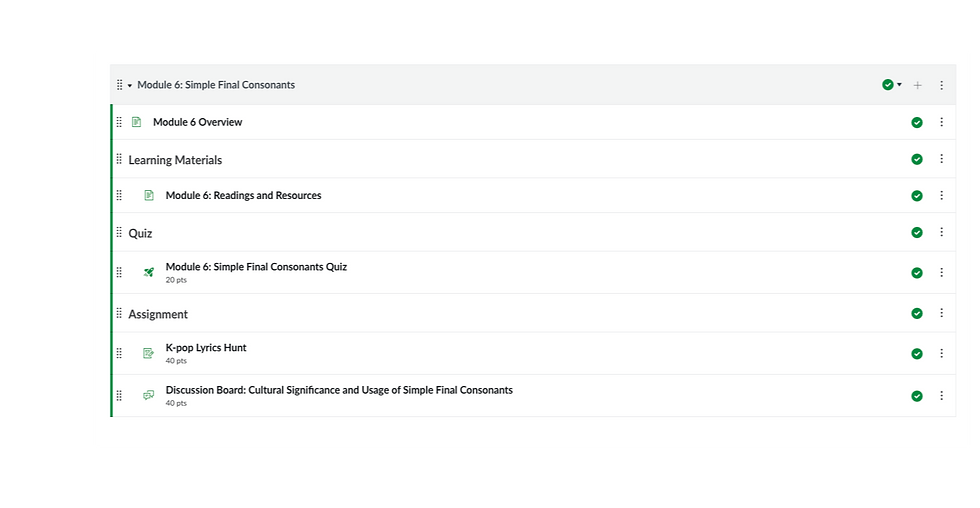
Canvas module view for KOR101 highlighting formative and summative assessments that support applied practice and cultural understanding of Korean final consonants (batchim).

Module overview highlighting aligned learning objectives, activities, and formative assessments for Korean final consonant pronunciation.

Discussion-based assessment promoting cultural analysis, pronunciation accuracy, and structured peer feedback aligned with course objectives.
Canvas module view for KOR101 highlighting formative and summative assessments that support applied practice and cultural understanding of Korean final consonants (batchim).
Alignment Matrix: Objectives, Activities, and Assessments

Results and Takeaways
As a capstone project, formal outcome data was not collected. However, this project reinforced that effective course design is not simply about delivering content. It is about creating a coherent learning experience where every objective, activity, and assessment serves a deliberate purpose.
-
Applying the Quality Matters Higher Education Rubric pushed me to evaluate alignment at every level of the course, ensuring that instructional decisions were grounded in learner needs rather than content familiarity. This standard of rigor has since become a foundation of my design practice.
-
Serving simultaneously as the instructional designer and subject matter expert required a conscious effort to separate content expertise from the learner perspective. Fluency in a subject does not guarantee clarity in its instruction — and maintaining that distinction was one of the most valuable lessons this project offered.
-
If I were to redesign this course, I would prioritize building stronger spaced repetition opportunities and more transparent learner progress indicators from the outset, ensuring learners have greater agency over their own growth throughout the eight modules.