top of page
Training Project:
Youth Volunteer Training
A scenario-based e-learning solution designed for high-turnover volunteer organizations reducing session time loss by 92.5% through immersive decision-making simulations.

-
Audience: Volunteer tutors at Seed Academy
-
Role: Instructional Design (action mapping, storyboarding, visual design, prototyping, authoring), eLearning Development
-
Tools & Frameworks: Articulate Storyline 360, Vyond, Figma, Gemini, Canva, Freepik, Google Docs
The Problem
Seed Academy, a Bay Area–based nonprofit serving refugee students in California, operates with about 80 youth volunteers who provide 1:1 tutoring to refugee students. These students often require significant time to establish emotional safety before they can actively engage in learning.
-
Overwhelmed Volunteers: Through a learner survey, I identified that many volunteers felt unsure how to handle recurring challenges, such as when students remained silent, appeared disengaged, or claimed to understand material despite clear signs of confusion.
-
Misread Moments: Highly motivated volunteers often interpreted these situations as personal failure rather than a natural part of the trust-building process.
-
Procedural Gap: Existing training focused heavily on procedures, leaving volunteers unprepared for the emotional, cultural, and relational realities of supporting refugee learners. This gap led to decreased confidence and impacted long-term volunteer engagement.
The Solution
After consulting closely with the Refugee Coordinator, Head Teachers, and other key stakeholders, I developed an interactive eLearning module tailored to the unique needs of Bay Area-based youth volunteers, designed to address both the instructional and relational dimensions of mentorship.
-
Consistent Onboarding: The eLearning format ensured consistent, high-quality onboarding for volunteers who join on a rolling basis throughout the year, eliminating the need for repeated in-person orientation sessions.
-
Flexible Access: Volunteers can prepare independently according to their academic schedules, removing barriers to participation.
-
Scenario-Based Learning: By incorporating scenario-based learning rooted in real tutoring challenges identified through survey data and coordinator insights, the module shifted the focus from procedural instruction to emotional intelligence, cultural responsiveness, and reflective decision-making.
My Process
To identify the right learning solution, I followed an ADDIE-informed design process with a strong emphasis on analysis.
-
Dual Role Advantage: As both an instructional designer and a volunteer coordinator at Seed Academy, I partnered with the Refugee Coordinator and Head Teachers from each class to review the organization's mission and 1:1 buddy model, paying particular attention to the social-emotional and cultural realities refugee students face while adjusting to new educational environments.
-
Evidence-Based Design: Drawing from survey data, coordinator consultation, and firsthand experience supporting refugee-centered programming, I designed realistic tutoring scenarios that mirrored authentic session dynamics.
-
Behavioral Focus: The eLearning emphasized behavioral and emotional decision-making:
When to wait
When to pivot instructional strategies
When to seek support
Rather than focusing solely on task-based instruction.
Action Map
To drive measurable behavioral change, I developed an action map based on backward design principles. I established the primary goal of creating an emotionally safe 1:1 tutoring environment and reverse-engineered the specific, observable actions required from tutors to achieve it.
By analyzing volunteer survey data and conducting deep-dive consultations with the Refugee Coordinator, I identified 10 Critical Moments where sessions were most at risk of disengagement. Specifically, I prompted Gemini through 12+ revision cycles to ensure each distractor reflected authentic cognitive biases — urgency, authority, and emotional overwhelm — drawn directly from volunteer survey data..
This action map served as the rigorous foundation for the scenario-based eLearning. Each branch mapped directly to decision points in the storyboard, allowing volunteers to navigate safe failures in a virtual setting and build the practical confidence needed for their in-person sessions.

Text-Based Storyboard
After completing the action map, I transitioned into the design phase by developing a text-based storyboard to serve as the project's blueprint. My goal was to immerse volunteers in a simulated real-world experience where they encounter common tutoring challenges and must choose the most effective response.
I designed three branching scenarios based on authentic refugee tutoring situations, such as student hesitation or confusion. Each scenario features a correct path and two distractors with memorable consequences, allowing learners to practice in a safe, risk-free environment.
To replicate the support provided in actual sessions, I introduced a Mentor character—the Volunteer Coordinator. Much like the on-site staff at Seed Academy, this mentor provides a steady, caring presence, guiding volunteers through new situations and setting clear expectations for their in-person experience.


The module opens outside Seed Academy, where volunteers approach the building and check in at the front desk, mirroring the exact arrival sequence of their first day. Learners must click the front door to enter and interact with the check-in tablet to proceed, embedding the physical routine into the learning experience itself.


Visual Mockups
Using Canva, I created mockups that balanced professionalism with a warm, approachable aesthetic. I established a cohesive UI kit with a calming color palette and intuitive navigation, ensuring the interface was "clean" and "learner-friendly" for tech-savvy youth volunteers.

Question Wireframe

Question Basic Mockup

Question High-Fidelity Mockup

Interactive Prototype
To bring the storyboard to life, I developed an interactive prototype using Articulate Storyline 360 and Vyond. I used Vyond to design calm, realistic classroom environments with subtle animations and neutral facial expressions, ensuring the visual tone remained professional and emotionally non-threatening for youth volunteers.
Instead of using text-heavy feedback, I implemented a “show, not tell” approach. Learners observe changes in the student’s body language and engagement based on their choices, shifting the focus from "right or wrong" answers to affective decision-making and emotional impact.
In Storyline, I utilized variables and triggers to manage complex branching, track learner progress, and control a persistent mentor support button that acts as a visible safety net. Accessibility was a core priority, integrated through alt text for visual elements and careful review of text contrast and spacing to ensure a learner-centered experience.
All voiceovers were produced using Articulate Storyline's AI Text-to-Speech, delivering consistent narration across all branches and making future content updates significantly easier to scale.
Creating in Vyond

Developing in storyline

Full Development
Based on feedback from the interactive prototype, I implemented advanced technical features to enhance both learner immersion and administrative efficiency.


From Feedback to Functional Design
-
Enhancing Immersion: Users expressed a desire to experience the actual arrival protocol rather than simply clicking a "Start" button. In response, I developed an on-site tablet check-in sequence that mirrors the physical entry process at Seed Academy.
-
Automated Certification & Validation: Using Articulate Storyline variables and triggers, I engineered an automated certification system that captures the learner's name and completion date to generate a personalized, downloadable certificate, eliminating the administrative burden of manual tracking and freeing program coordinators to focus on direct volunteer mentorship.
Results and Takeaways
This project was evaluated using the Kirkpatrick Model of Evaluation across all four levels: Reaction, Learning, Behavior, and Results.
Step 1: Reaction – Measuring Learner Confidence
-
Data Collection: A post-training survey was administered immediately following the issuance of the certificate to measure engagement and perceived relevance.
-
Key Indicator: The evaluation focused on "Self-Efficacy," specifically measuring how confidently volunteers felt they could respond to the three core scenarios covered in the training.
Step 2: Learning – Performance-Based Rubric
-
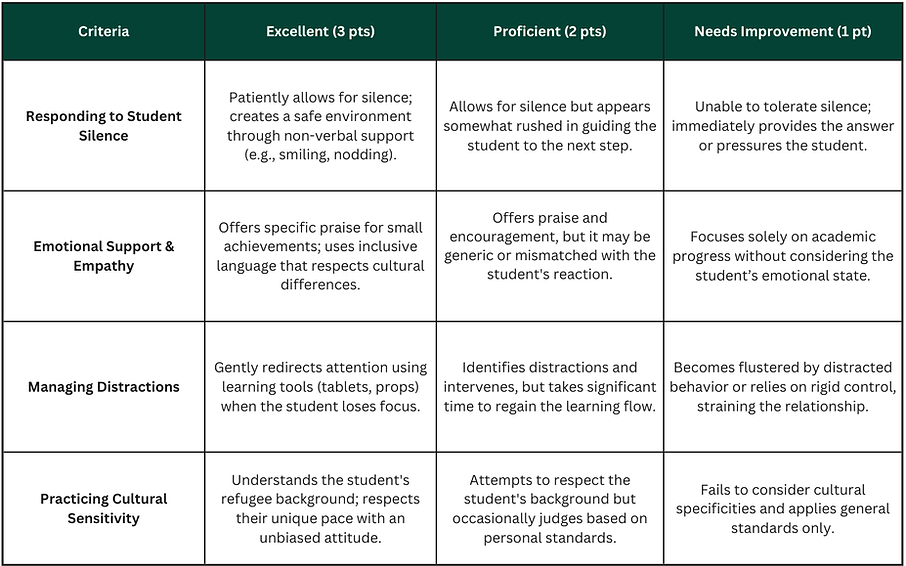
Instrument Design: A Volunteer Performance Rubric was developed for coordinators to use during the initial "Shadowing" sessions with new volunteers.
-
Evaluation Pillars: Beyond simple knowledge retention, the rubric objectively assesses practical application based on 'Affective Decision-Making' and 'Cultural Sensitivity.'
-
Verification Process: Using the submitted certificate as a prerequisite, shadowing sessions are scheduled to verify that the learner can translate theoretical knowledge into actionable skills.
Volunteer Performance Rubric
Step 3: Behavior – On-site Application & Mastery
-
Continuous Tracking: Performance is monitored over the first 1–3 months to ensure consistent application at a 'Proficient' level or higher based on the rubric.
-
Behavioral Goal: The target is for 90% of graduates to follow standardized response guidelines during critical on-site challenges.
Step 4: Results – Educational Effectiveness & Organizational Impact
This final phase evaluated the real-world impact of the scenario-based training on "Session Time Loss" the critical moments when instruction halts due to a volunteer's inability to manage silence or emotional distress.
1. Quantitative Impact: Data-Validated Efficiency
-
While the initial project goal was a 50% reduction in time loss (from 10 minutes to 5 minutes), the actual data revealed a much more significant improvement.
-
Rigorous Sample Scale: The evaluation was based on a comprehensive dataset of 1,612 individual session units, tracking 52 volunteers across 31 active sessions. Time loss was recorded in real time by each class's Head Teacher during live tutoring sessions.
-
Normalized Performance Achievement: The average session loss per volunteer was reduced to 0.75 minutes, representing a 92.5% improvement from the baseline. These results far exceed the initial 5-minute target. (Baseline: 10m ➔ Target: 5m ➔ Actual: 0.75m)
2. Behavioral Correlation: Mastery of the Rubric
-
The drastic reduction in lost time serves as quantitative proof that the behaviors defined in the Level 2 Performance Rubric were successfully transferred to the field.
-
Evidence of Transfer: The data indicate that volunteers moved from "Needs Improvement" (pressuring students during silence) to the "Excellent" tier—patiently allowing for silence and providing non-verbal support to maintain a safe learning environment.

bottom of page